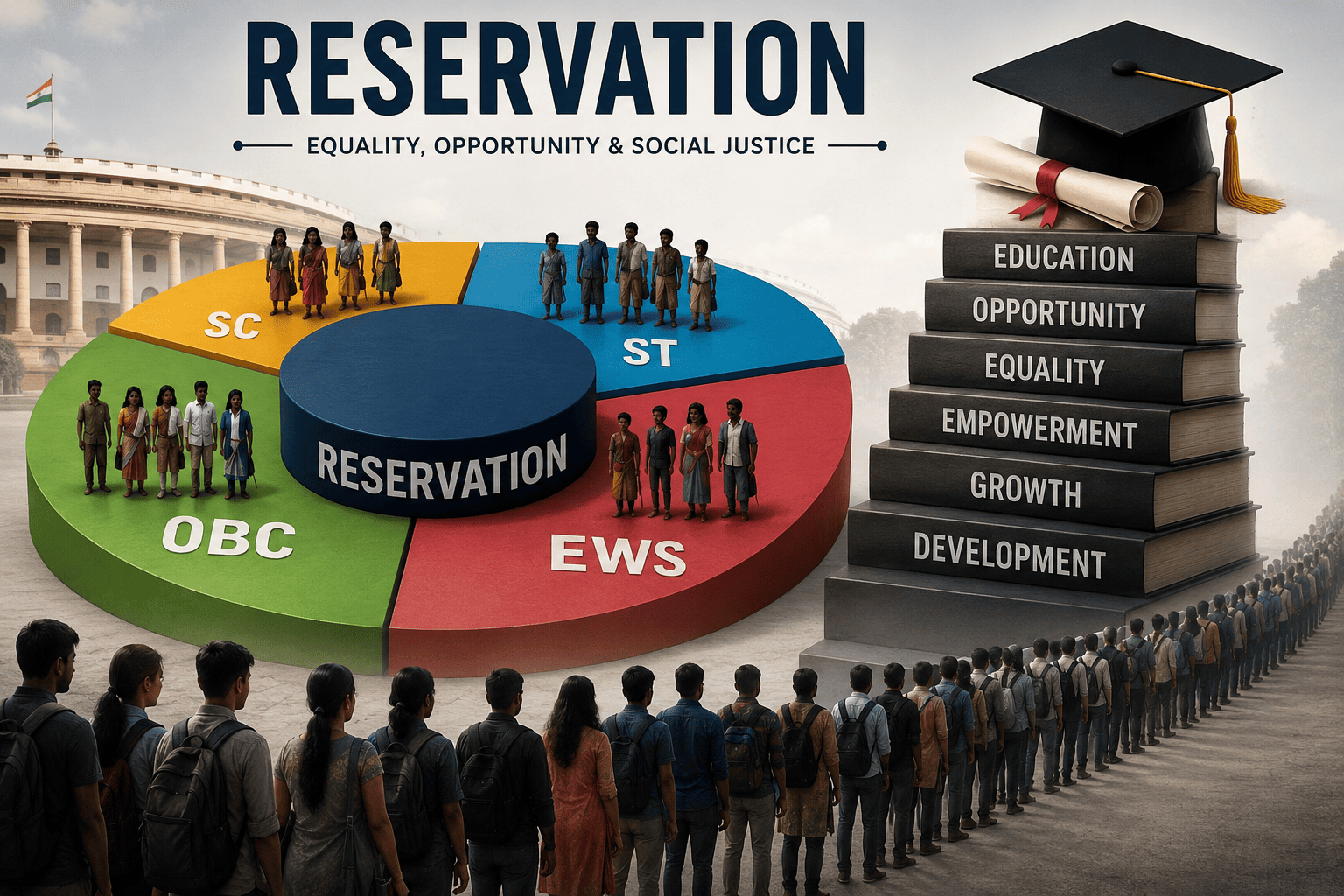
The debate over India Reservation System Reform has become one of the most discussed political and social issues in the country. While reservation policies were originally introduced to address historical discrimination and provide opportunities to disadvantaged communities, critics argue that the system now requires significant reform to meet the needs of a modern and competitive India.
More than 75 years after independence, reservation continues to play a major role in admissions, government jobs, and public institutions. However, many critics believe that the system has evolved far beyond its original purpose and now requires a comprehensive review.
Merit and Performance Concerns in India Reservation System Reform
One of the primary arguments supporting India Reservation System Reform is the concern over merit and performance. Critics argue that highly competitive sectors such as medicine, engineering, scientific research, civil services, and higher education should prioritize ability and performance above all other factors.
According to opponents, lowering admission or recruitment thresholds based on category rather than achievement may affect competitiveness and discourage high-performing students. They believe that excellence should remain a key criterion in sectors that directly impact national development.
Reservation and Vote-Bank Politics
Another major concern in the India Reservation System Reform debate is the growing influence of electoral politics. Critics claim that reservation has increasingly become a political tool used by parties to attract specific voter groups.
Promises of new quotas often emerge during elections, making reservation a highly sensitive political issue. Opponents argue that this environment discourages meaningful discussions about reform because any attempt to review the system is often portrayed as opposition to social justice.
The Creamy Layer Debate
The creamy layer issue is frequently cited by supporters of India Reservation System Reform. Critics argue that reservation benefits are often concentrated among relatively well-off families within reserved categories, while many genuinely disadvantaged individuals remain excluded.
As a result, many experts and policymakers have suggested that economic hardship should receive greater consideration alongside social disadvantage. They argue that support should reach those who need it most rather than being repeatedly accessed by the same families over generations.
Impact on Students and Employment Opportunities
Every year, millions of students compete for a limited number of university seats and government jobs. Critics of the current system argue that frustration arises when candidates with higher examination scores fail to secure admission while candidates with lower scores gain entry through reserved quotas.
Supporters of India Reservation System Reform believe that this perception can create resentment among young people and contribute to social divisions. They argue that a fair and transparent system should maintain public confidence while continuing to support disadvantaged communities.
Global Competitiveness and National Development
Critics also argue that India must strengthen merit-based selection if it wants to compete with global leaders in technology, artificial intelligence, semiconductor manufacturing, aerospace, and scientific research.
Countries investing heavily in innovation often focus on identifying and nurturing top talent. Advocates of India Reservation System Reform believe that India should create world-class educational opportunities for all citizens while ensuring that the most qualified candidates are selected for critical roles that influence the country’s future.
Brain Drain and Talent Migration
Another concern linked to India Reservation System Reform is the issue of brain drain. Thousands of skilled Indian professionals pursue education and careers abroad each year.
While migration decisions are influenced by multiple factors, critics argue that perceived limitations in domestic opportunities may encourage some talented individuals to seek countries where admissions and recruitment are viewed as more merit-based.
Alternative Solutions Proposed by Critics
Importantly, many critics do not advocate removing support for disadvantaged communities. Instead, they recommend alternative measures such as:
- Scholarships for economically weaker students
- Free and quality education
- Skill development programs
- Coaching assistance for competitive examinations
- Better rural schools and infrastructure
- Income-based financial support
- Career counseling and mentorship programs
Supporters of India Reservation System Reform argue that empowering individuals before competition begins is more effective than altering selection criteria afterward.
The discussion surrounding India Reservation System Reform is complex and often emotional. Critics acknowledge the importance of social justice but argue that the system should evolve to address modern realities. They believe that India must balance equality of opportunity with merit, innovation, and excellence.
As the country seeks to become a global economic and technological leader, the debate over India Reservation System Reform is likely to remain central to discussions about education, employment, and national progress.
