Table of Contents
- What Triggered the India Energy Crisis?
- Why the Middle East Conflict Matters
- India’s Dangerous Dependence on Imported Energy
- The Solar Opportunity India Ignored
- How Politics and Bureaucracy Delayed Progress
- The Cost of Inaction
- Conclusion
What Triggered the India Energy Crisis?
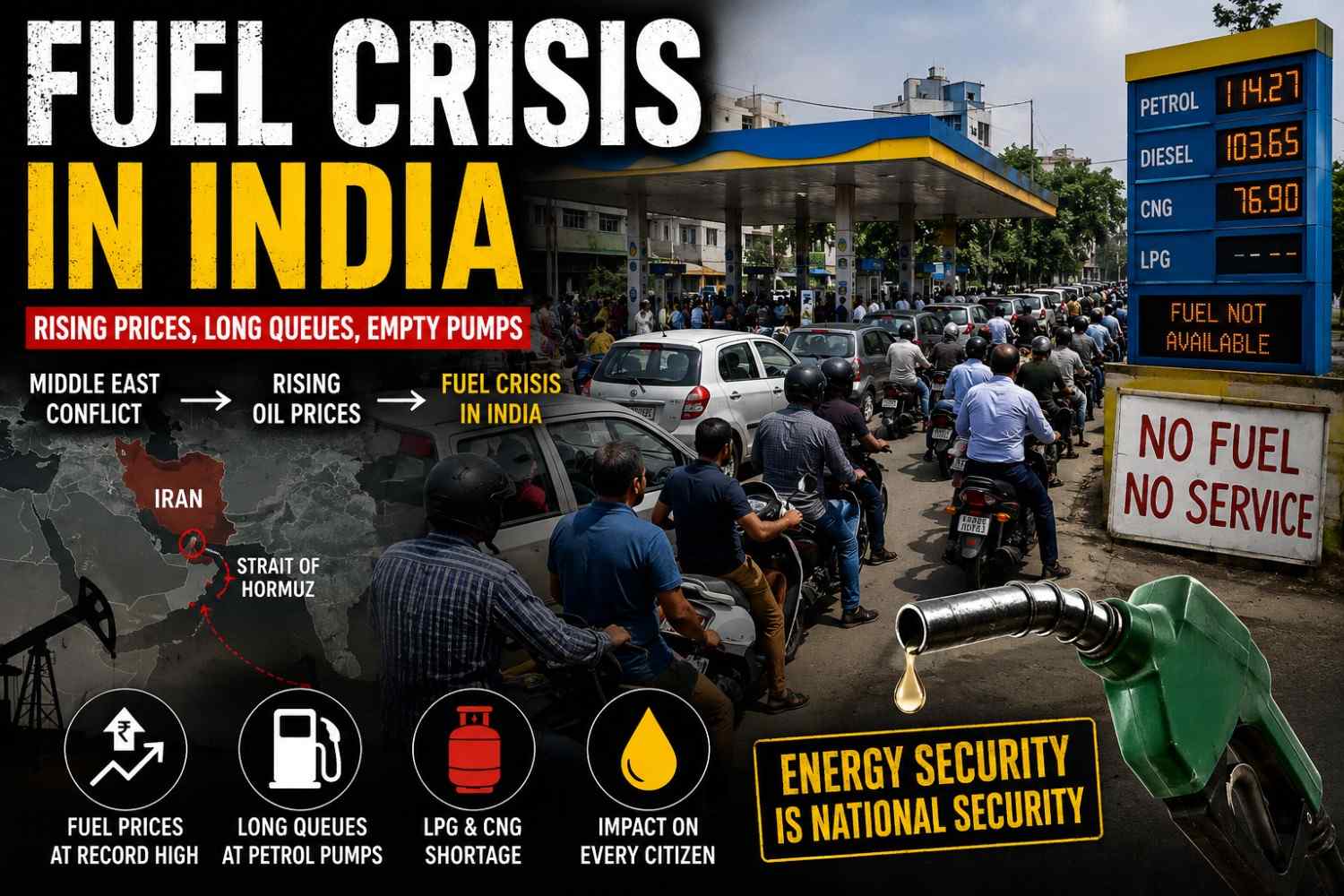
The India Energy Crisis has become one of the biggest challenges facing the country in 2026. As tensions continue to rise between the United States and Iran, the entire Middle East has become increasingly unstable. While the conflict is taking place thousands of kilometers away, its consequences are being felt across the world, including in India.
The biggest concern is the Strait of Hormuz, one of the world’s most important energy routes. A significant portion of global oil and gas supplies passes through this narrow waterway. Any disruption immediately affects energy prices, fuel availability, and global supply chains.
As a result, the India Energy Crisis has intensified, with rising fuel costs, pressure on households, and concerns about long-term energy security.
Why the Middle East Conflict Matters
The Middle East remains a critical source of energy for many countries, including India. When geopolitical tensions increase, oil prices often rise sharply.
The current conflict has once again exposed how vulnerable energy-importing nations can be. India imports a large share of its crude oil requirements, making it highly sensitive to disruptions in international markets.
The India Energy Crisis is therefore not only about temporary price increases. It highlights a deeper structural weakness that has existed for decades.
India’s Dangerous Dependence on Imported Energy
India is one of the fastest-growing economies in the world, but its energy demand continues to grow faster than domestic production.
Every major international crisis involving oil-producing regions places pressure on India’s economy. Higher fuel prices increase transportation costs, raise inflation, and make daily life more expensive for ordinary citizens.
The India Energy Crisis demonstrates the risks of relying heavily on imported crude oil and natural gas.
Experts have warned for years that India needs a diversified energy strategy. Yet despite repeated warnings, the country remains heavily exposed to global energy shocks.
The Solar Opportunity India Ignored
One of the most striking aspects of the India Energy Crisis is that India possesses enormous renewable energy potential.
Large parts of the country receive abundant sunlight for most of the year. Solar energy could significantly reduce dependence on imported fossil fuels while also lowering long-term energy costs.
Imagine millions of homes, schools, hospitals, factories, and government buildings generating electricity through rooftop solar systems. Such an approach could strengthen energy security and reduce vulnerability to international conflicts.
However, the pace of implementation has often been slower than expected.
How Politics and Bureaucracy Delayed Progress
Critics argue that the India Energy Crisis is not solely the result of international events. It is also a consequence of decades of political delays, bureaucratic inefficiency, and poor long-term planning.
Infrastructure projects frequently face years of approvals, paperwork, and administrative hurdles before construction even begins.
In many cases, projects become more expensive by the time they are approved. Meanwhile, energy demand continues to rise, creating larger gaps between supply and requirement.
The result is a cycle where planning struggles to keep pace with the country’s growing needs.
Many observers believe that faster decision-making, greater transparency, and stronger accountability could have accelerated India’s transition toward energy independence.
The Cost of Inaction
The consequences of the energy Crisis extend beyond fuel prices.
Energy insecurity affects businesses, transportation networks, manufacturing, agriculture, and household budgets. It also limits economic resilience during global emergencies.
Every crisis serves as a reminder that energy security is not merely an economic issue—it is a strategic national priority.
Countries that invest in diversified energy sources, renewable technologies, and modern infrastructure are generally better prepared to withstand external shocks.
The Energy Crisis has revealed important lessons about energy security, long-term planning, and national preparedness. While the conflict in the Middle East may have triggered the current challenges, the underlying vulnerabilities have existed for decades.
India has enormous potential in solar, renewable, and domestic energy development. The question is whether policymakers can move quickly enough to reduce dependence on imported energy and prepare the country for future crises.
The cost of delay is becoming increasingly visible. The cost of preparation, however, may be far less than the price of another energy shock.
